
Asbestos · A practical guide
Asbestos: what to check before work starts
Asbestos is a hazard when fibers get into the air. Material in good condition is usually safer left alone than disturbed — so the question is not whether it is there, but whether anything is about to cut into it.
If you read nothing else
- 01Stop work. Do not cut, sand or break the material.
- 02Close the room and keep people out of it.
- 03Photograph it and note the year the building was built.
If you suspect it, in order
This is a different kind of guide, because there is usually no emergency — there is a decision. Something is about to be cut, sanded, drilled or demolished, and the question is whether that is safe to do.
- Stop work on the material. Do not cut, break, sand, drill or scrape it, and do not try to see what is inside it.
- Turn off fans, and the furnace or air conditioning, so dust is not carried through the building. Close the door on the room.
- Keep people out, particularly children and anyone who is pregnant, and do not let anyone sweep or vacuum the debris.
- Photograph the material where it sits, and write down where it is — which room, which surface, roughly how much of it. That list is what shapes the sampling plan.
- Note when the building was built and when it was last renovated. Asbestos was used into the 1980s, and a 1920s building re-done in 1975 has 1975 materials in it.
- Ask anyone working on the building to stop until it has been tested. A contractor who shrugs and says it is fine has told you something about how they work.
If material has already been disturbed, do not clean it up yourself with a household vacuum or a broom. Leave the area closed and call.
What makes it worse
The instinct to tidy up is the thing that turns a contained hazard into an exposure.
- Do not break a piece off to see whether it looks like asbestos. You cannot tell by looking, and it is not a material that gives you a second chance to be careful.
- Do not sweep, dust, or vacuum it with an ordinary machine. A household vacuum exhausts fine fibers back into the room.
- Do not wet it down and pull it out yourself. Wet methods are for trained crews working inside containment with the right equipment and disposal route.
- Do not put it in the household trash or a dumpster. Asbestos waste has its own handling and disposal route, and the paperwork is part of it.
- Do not let a renovation or a water repair start on the assumption that it is probably just plaster. Joint compound, floor tile and the mastic under it, pipe insulation, boiler lagging, roof cement and vermiculite attic insulation are all common.
- Do not assume a small job is exempt. A few square feet of disturbed material still puts fibers into the air you are breathing.
Where it hides in an older Chicago building
In Chicago’s older housing stock, asbestos turns up in places that are not obvious — and in the places a water or fire repair has to open.
Floor tile and the black mastic under it; the joint compound and texture coat on drywall and plaster; pipe and boiler insulation, especially on heating systems; the board around a furnace or a flue; roof cement and flashing; window glazing and putty; vermiculite insulation in an attic or a wall cavity; and older sheet vinyl with a paper backing.
Two conditions matter. Friable material crumbles under hand pressure and releases fibers easily. Non-friable material is bound into something solid, like a floor tile, and is a problem mainly when it is cut, sanded or broken. Both need to be known about before work starts.
Lead paint usually lives in the same buildings and the same walls. A pre-1978 building being renovated is a lead question as well as an asbestos question, and the two are handled together.
The EPA’s Renovation, Repair and Painting rule covers paid work that disturbs paint in pre-1978 housing. Illinois sets its own requirements for asbestos in renovation and demolition, and a licensed inspector is who tells you which apply to your job.
What insurance usually covers, and what it often does not
This is the one where the honest answer is usually no. Homeowners and commercial property policies commonly treat asbestos as a pollutant, and pollution is commonly excluded.
Usually covered
- Rarely, abatement made necessary by a covered loss — a fire or a burst pipe that damaged asbestos-containing material — and usually only under a limited pollution or ordinance provision.
- Sometimes, the cost of getting the building back to a safe, occupiable condition where the policy includes ordinance-or-law cover. Read that endorsement, and ask specifically about it.
Often not covered
- Planned abatement as part of a renovation. That is a project cost, not a loss, and it usually comes out of the renovation budget.
- Testing you chose to do for a renovation of your own.
- Most cleanup of asbestos-containing material discovered during a repair, once the pollution exclusion is applied.
- Anything in a commercial or rental building framed as a pollution condition rather than physical damage, unless there is specific cover.
Two ways this goes wrong. One: assuming the policy will pay for abatement, then finding out it will not after work has started. Two: commissioning a report you did not need for a job that would not have disturbed anything. Ask before either.
Do it yourself, or call us
There is no safe do-it-yourself removal. What a homeowner can do is the part before and around it, and that part matters more than people expect.
You can handle this
- Leave suspect material alone if it is intact and not in the way. Sealing or enclosing it in place is work for a licensed contractor — not disturbing it is entirely within your control.
- Photograph, list and locate every suspect material before a renovation, and give that list to everyone who quotes the work.
- Choose a contractor who asks for the report before starting. That is the single best signal you will get.
Call instead
- Any renovation, repair or demolition that will cut into, sand or remove a suspect material.
- Damaged material — crumbling pipe insulation, a broken tile with visible dust, an attic full of loose fill.
- A water, fire or mold job that means opening a wall, ceiling or floor in a pre-1980 building.
- A commercial, multi-unit or child-occupied space, where the requirements are stricter.
- A real estate transaction, a refinance, or a permit application that asks for an asbestos report.
- A case where material was already disturbed and you are not sure what went into the air.
What happens from the first call
Inspection, sampling, a report, then abatement or a plan to leave it alone.
- 01
You call and describe the project
What you are planning to do, in which rooms, and when the building was built. That is enough to say whether an inspection is needed and what it should cover.
- 02
We inspect and sample
A licensed inspector records the materials in place and takes small samples, which go to a laboratory for analysis. Sampling is done so the material is not disturbed in the process.
- 03
You get the report
What is present, exactly where, in what condition, and what the options are for each material. This is the document the abatement contractor, the permit office and a future buyer will all want.
- 04
Abate, or manage it in place
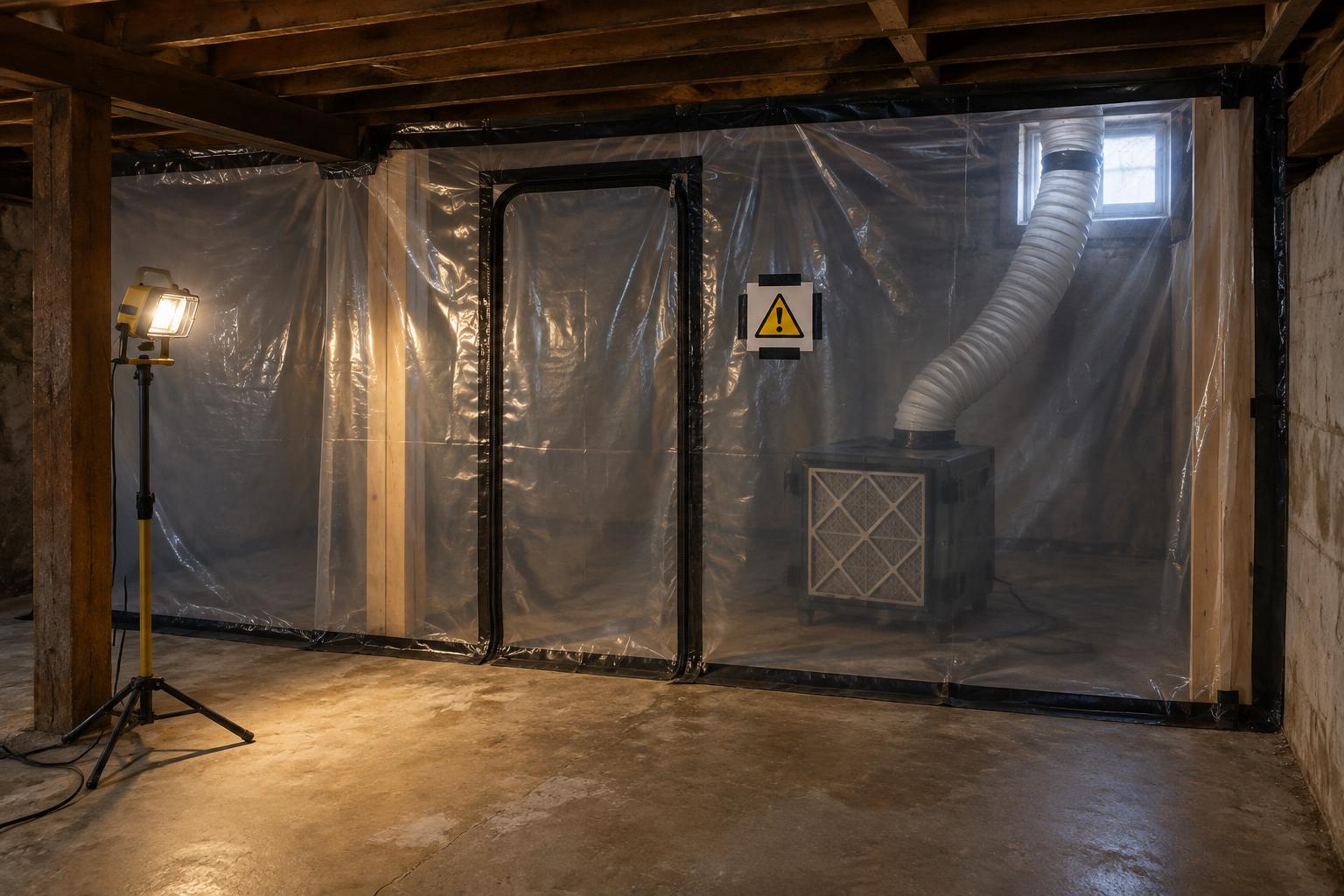
Where removal is needed: containment with critical barriers and negative air pressure, HEPA filtration, wet methods, and a decontamination setup for the crew. Where it is not, a plan that keeps the material intact.
- 05
Clearance
A visual inspection and air sampling by an independent party before containment comes down and the space is used again. The clearance is what says the work is finished.
- 06
Disposal and records
Material is packaged, labelled, transported and disposed of under the rules, with the manifests kept. Those records are worth having at a sale, at an inspection, or at the next renovation.
General guidance for Chicago-area buildings. It is not a substitute for an on-site assessment, a lab report, or a reading of your own policy.
Not sure where you stand?
Call for an assessment.
If a contractor is about to open a wall in an older building, that is the moment to ask. Call and we will tell you what needs testing before anything is cut.
Open 24 hours, 7 days a week, including emergencies.